
[Podcast Episode #34] Stop Optimizing Your Life. Start Designing It.
Episode #34
Your life does not drift into significance. It has to be designed. In this episode, we talk about why optimization is not enough, and how business owners can begin with the end in mind while also telling the truth about where they are right now. Through stories from the Medici Conference, childhood road trips, global relationships, and personal reflection, they explore how to stop living by default and start becoming the architect of a more intentional life.
Some topics covered are:
- Why optimization is not enough
- The two GPS points every life needs
- Beginning with the end in mind
- Choosing the right mountain to climb
- The four forces shaping your direction
- Turning past pain into purpose
- Building trusted relationships before crisis
- Taking an honest inventory of your life
- Creating rhythms of reflection
- Designing your next intentional step
- And more…
Episode Summary
There is a kind of success that looks impressive from the outside but feels strangely accidental from the inside. You can build, grow, earn, travel, and still wake up one day wondering how you ended up on a mountain you never meant to climb.
That was the tension Philip brought into the conversation after the Medici conference: a life of significance does not happen by drift. It has to be designed.
The Conference Was Not About Content
Cris began with what stood out most from the gathering. It was not the speeches, the dinners, or the beautiful setting on the island. It was the depth of trust that had formed over time.
Most conferences begin with business cards and small talk. This one felt different because people were not starting from zero. They were picking up conversations that had been growing for years. The point was not networking. It was building the kind of relationships that can carry a family, a business, and a legacy through uncertain times.
Relationships Become A Safety Net
Cris described the Medici community as a safety net. In a world shaped by geopolitical chaos, wars, shifting markets, and fragile travel routes, trusted relationships across borders are no longer a luxury. They are part of survival.
If crisis comes, you need more than information. You need people. You need friends in other countries, trusted families in other contexts, and relationships strong enough to matter before you need them. History has often favored families who knew how to build beyond their local world.
The Paper Map In The Family Car
Philip then reached back into a childhood memory. It was the early 1990s, before GPS and Google Maps. The family was driving through the south of France on the way to Spain. His father was behind the wheel, his mother had a paper map spread across the dashboard, and two brothers were fighting in the back seat.
They knew the destination. They had a house waiting for them in Spain. But at some point, they had to stop at a gas station and ask the most basic question: where are we?
That became the central picture. A meaningful life requires two coordinates. You need to know where you want to go, and you need to know where you are right now.
You Need To Choose Your Mountain
Cris connected this idea to money. Most financial books begin with a simple exercise: define your number. Whether it is five million, ten million, or something else, the number matters because it gives shape to the strategy.
But life is larger than money. The same principle applies to family, business, health, relationships, and impact. You cannot reverse engineer a life you have never defined.
Philip warned that if you do not choose your mountain, someone else already has. Parents, peers, past pain, and authority figures quietly shape what you believe a good life should look like. These influences are not always bad, but they must be examined. Otherwise, you may spend decades proving something to a dead father, keeping pace with the wrong peers, or building a future that is only a reaction to old pain.
Pain Can Push, But It Cannot Design
Cris told the story of a woman he met in New York. She had come from an Iranian background and carried a history of severe abuse. Her story could have easily become a prison.
Instead, she had faced it, named it, worked through it, and transformed it into a life that now helps others. She mentors and coaches people out of the very kind of darkness that once marked her.
That is not the same as pretending pain did not happen. It is the opposite. It is looking at your story clearly enough that it stops controlling you from the shadows.
Reality Must Be Defined Honestly
The second coordinate is your current location. Some people are strong at dreaming but weak at facing reality. They know where they want to go, but they have not honestly assessed their marriage, finances, health, business, or family life.
Cris added another travel story, this time from Ethiopia. He had flown there to document wells funded through Charity Water. He had GPS coordinates for the wells, but once he stood in northern Ethiopia with numbers on a piece of paper and no usable map, the coordinates were not enough. He still did not know how to orient himself.
That is how many people live. They have goals, language, and ambition, but only a superficial grasp of their present reality.
Reflection Turns Intention Into A Life
Philip closed with the need for rhythm. Businesses have quarterly meetings, off-sites, reports, and reviews. But many people never hold the same kind of meeting for their own life.
A designed life requires regular reflection. Daily, weekly, monthly, quarterly, and yearly rhythms help you ask better questions: Where am I? Where am I going? What is the next faithful step?
Cris added that this should not become a heavy, joyless exercise. Life changes. People grow. The point is not to freeze your future in place, but to keep returning to the work of choosing it.
The unexamined life does not merely remain unexamined. It gets quietly designed by someone else.
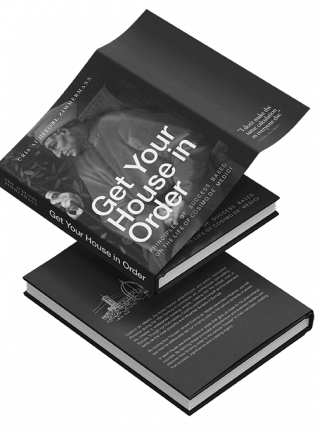
Get a free copy of "Get Your House in Order"
Principles of success based on the life of Cosimo de’ Medici by Cris Auditore Zimmermann