
[Podcast Episode #28] Productivity Boosters That Save You 10 Hours a Week—Guaranteed
Episode #28
Ever feel “always on” but rarely satisfied with the results? In this episode we take a scalpel to modern busyness and rebuild your week around outcomes, not alerts. From killing inbox addiction to installing clear access protocols, this conversation shows how to trade reactive work for deliberate results—and save at least 10 hours every week.
Some topics covered are:
- Email triage with assistants/AI
- Filter days by urgent vs. important
- Block interruptions with strict access rules
- Batch messages to stay focused
- Sprint weeks for execution; off weeks for strategy
- Ivy Lee: three outcomes per day
- Outcome-first, minutes-long meetings
- Capture-to-delegate to keep work moving
- And more…
Episode Summary
There is a quiet exhaustion that settles over many business owners, and most of them do not even recognize it. It is not the exhaustion of hard work. It is the exhaustion of constant interruption.
Philip opened the conversation with a bold promise: if you truly understood what we are about to say, you could save ten hours a week . Not by waking up earlier. Not by pushing harder. But by redesigning the way you work.
Two Weeks, Two Modes
Cris illustrated this with a story from the start of his year. The first week of January, he disappeared into the Swiss Alps with his family. No emails. No calls. No scattered conversations. Just skiing, long evenings, and space to think. In that silence, major personal and business decisions were made. Decisions that would have been impossible in the noise of daily operations.
The very next week looked completely different. Fifty meetings. Back to back Zoom calls. Pure execution. No drifting. No multitasking. Just focused conversations aimed at specific outcomes. By Friday evening, he went out alone to celebrate, not because he survived the week, but because he achieved exactly what he set out to achieve.
Both weeks were productive. One was reflective and strategic. The other was intense and operational. The common thread was not activity level. It was intentional design.
The Illusion of Urgency
Most entrepreneurs live in a blurred version of both. They try to think strategically while answering emails. They attempt deep work between random phone calls. They are permanently on, yet rarely fully present. And then they wonder why they feel behind.
Email is often the biggest illusion. It feels important. It feels responsible. But it is usually someone else’s urgency invading your priorities. Every time you check your inbox, you open a loop in your mind. That loop stays open until it is resolved. Multiply that by dozens of emails, messages, and notifications, and you begin to understand why your attention feels fragmented.
The distinction between urgent and important, popularized in The 7 Habits of Highly Effective People by Stephen Covey, is not theoretical. It is deeply practical. Urgent things scream. Important things whisper. Strategy whispers. Vision whispers. Your inbox screams.
If you are constantly reacting, you are not leading. You are managing interruptions.
Designing for Focus
Philip shared how he protects his attention with simple rules. Unknown numbers do not get answered. Meetings are clustered into defined windows. Mornings are reserved for deep work. Before the day ends, he defines the three outcomes that must be produced tomorrow. Not activities but outcomes. What does winning look like?
That question alone changes how you show up. If you know what a win looks like, you do not wander into conversations. You enter them with purpose.
Cris approaches productivity with equal intentionality, but often through environment. There are places where he thinks. Places where he executes. Even specific tasks he only does on airplanes. It may sound old school, but the principle is timeless. Environment shapes output. When you design your physical and digital spaces deliberately, your mind follows.
Getting Your House in Order
Perhaps the deepest insight in all of this is that productivity is not about doing more. It is about alternating well. There are seasons of deep thinking. There are seasons of intense execution. Both are necessary. Both are valuable. But they must not be mixed carelessly.
The entrepreneur who is always accessible, always reactive, always answering, will eventually become the bottleneck in his own business. The one who builds systems, protects attention, and defines outcomes will multiply his impact.
Ten hours a week is not saved through hacks alone. It is saved when you decide that your attention is too valuable to be casually interrupted.
And that decision is the first step in getting your house in order.
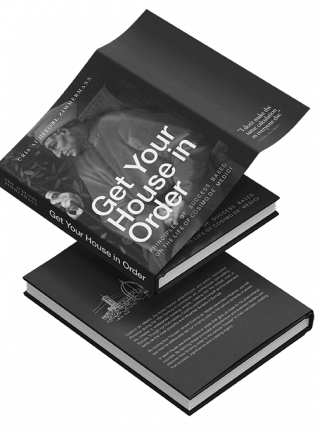
Get a free copy of "Get Your House in Order"
Principles of success based on the life of Cosimo de’ Medici by Cris Auditore Zimmermann