
[Podcast Episode #35] When Did You Last Scare Yourself? The Case for Calculated Risk
Episode #35
Fear has a way of exposing the truth: either we are about to do something meaningful, or we are about to do something foolish. In this episode we dig into that tension with a question we keep coming back to as business owners: when did you last scare yourself?
Some topics covered are:
- Calculated risk vs. playing entrepreneur
- Leaving the boat to grow
- Motorbikes, parenting, and responsible risk
- Defining your personal risk appetite
- What first-generation wealth creators know about risk
- Big decisions, uncertainty, and 3 a.m. doubt
- Building a self-managing business before you feel ready
- How fear of failure shapes courage
- And more…
Episode Summary
There is a kind of fear that tells you to stop. There is another kind that tells you you are standing at the edge of growth. The hard part is learning the difference.
For business owners, this difference matters. Playing it safe can preserve what you have built, but it can also quietly shrink the life out of you.
Risk Is The Entrepreneur’s Native Language
Cris framed it plainly: risk is one of the great differentiators between true entrepreneurs and the people who only like the idea of entrepreneurship. Every serious builder eventually reaches a point where the next move cannot be fully guaranteed.
That does not mean recklessness. It means stepping beyond the normal borders of family expectations, market expectations, and personal comfort. Entrepreneurs do not merely manage what already exists. They venture.
The Line Between Courage And Foolishness
Philip brought the tension into focus. There is a thin line between taking risk and being foolish. Nobody should “bet the farm” on a whim, especially when people, families, and employees depend on the outcome.
But the opposite danger is just as real. A business owner can become so committed to safety that every decision becomes a repetition of yesterday. The company may still make money, but the owner stops growing. And when growth disappears, so does the sense of being fully alive.
A Father Learns The Risk Spectrum
For Cris, the topic is not only theoretical. It lives at home.
As a father of three teenage and young adult sons, he has watched risk show up in very practical ways. His oldest son, Carlos, has an appetite for adventure. One recent conversation centered on motorbikes. Cris was not mildly concerned. He was furious. He told Carlos, half seriously and fully emotionally, that he should not touch a motorbike license until he turned forty.
His point was not that all risk is bad. It was that risk sits on a spectrum. Some risks develop you. Others leave no room for error. A financial investment, a new business, a bold product launch, or a difficult conversation may stretch you. A motorbike accident may simply end the story.
Wisdom is not avoiding risk. Wisdom is knowing which risks deserve your courage.
Fear Often Arrives At Three In The Morning
Cris described a familiar scene for entrepreneurs. A major investment is ready. The notary appointment is scheduled. The documents are waiting. Then, in the middle of the night, fear arrives.
He remembered February and March of 2020, when the pandemic was beginning to unfold. He was on his way to sign a major property investment in Darmstadt. In the car, the news announced that President Trump was closing travel from Europe to the United States. Cris was supposed to fly to San Diego days later. Suddenly, the world felt unstable.
He still signed.
Not because the fear was fake, but because the decision had already been weighed. He knew that nobody builds anything significant by refusing to put their name on the line. The fear did not disappear. He moved through it.
The Book That Might Have Failed
Philip had his own recent moment of fear. He had written books before, but his new project was different.
Instead of writing another practical how-to book, he wrote The Self-Managing Business as a historical fictional story. He created Mark, a burned-out agency owner, who receives a letter from Cosimo de’ Medici inviting him to Florence. Through that story, Philip explored how the Medici Bank became not only powerful, but self-managing.
The risk was not financial in the usual sense. It was creative. Philip had only read a few fiction books in his life. He did not know whether the story worked. Yet he stood in front of around one hundred people at the Medici conference in Mallorca, handed out signed copies, and had no idea whether they would love it or quietly dismiss it.
That is a different kind of exposure. Not the fear of losing money, but the fear of being seen trying something new.
Sometimes You Ask Anyway
Philip told a smaller story from his student days in Canada. He saw a beautiful woman working at a supermarket checkout. For a while, he kept finding reasons to go there. Eventually, he decided not to keep looking from a distance. He asked her out for coffee.
She said she had a boyfriend.
He replied that he did not need coffee with her boyfriend. He wanted coffee with her. Still, she said no. He walked away.
The story is simple, but the lesson holds. Sometimes risk ends in rejection. Sometimes you put yourself out there and the answer is no. But a life built only around avoiding rejection becomes very small.
Your Culture Trained Your Risk Appetite
Cris pointed out that not every culture treats risk the same way. Germany, he said, is not naturally a risk-taking country. It is the land of engineers, and engineers are trained to make sure the bridge holds, the machine runs, and the building stands.
The United States often tells a different story. Risk becomes a badge of honor. Failure is more easily folded into the mythology of success. In Germany, bankruptcy can mark a person for life. In America, it can become chapter one of the comeback story.
In Conclusion
Every entrepreneur carries some inherited risk posture. Family, culture, school, and early work experience all teach us what is “safe” and what is “crazy.” The question is whether those lessons are still serving the future we say we want.
Calculated risk is not the absence of fear. It is the moment when fear is present, the cost has been counted, and you step forward anyway.
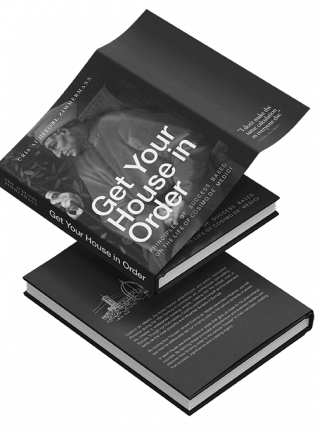
Get a free copy of "Get Your House in Order"
Principles of success based on the life of Cosimo de’ Medici by Cris Auditore Zimmermann