[Podcast Episode #37] Talk About Money With Your Kids: Raise Stewards of Wealth, Not Consumers of It.
Most families talk to their kids about grades, manners, and screens, then go silent on the thing that will shape their choices for decades: money. We want to change that. In this episode, Philip and Cris lay out a simple, repeatable way to teach financial literacy at home. They share the principles, the family meeting structure, and the mindset shift from discipline to systems so wealth becomes stewardship, not entitlement.
[Podcast Episode #37] Talk About Money With Your Kids: Raise Stewards of Wealth, Not Consumers of It.
Most families talk to their kids about grades, manners, and screens, then go silent on the thing that will shape their choices for decades: money. We want to change that. In this episode, Philip and Cris lay out a simple, repeatable way to teach financial literacy at home. They share the principles, the family meeting structure, and the mindset shift from discipline to systems so wealth becomes stewardship, not entitlement.
Tired of being the smartest person in the room? In this episode we break open a better path: become the conductor who assembles and orchestrates a circle of genius. Drawing on the Renaissance playbook of Lorenzo de Medici and the realities of modern boardrooms, we show how curated, cross‑disciplinary advisors can change the trajectory of a business faster than any internal meeting ever will.
Deals don’t fall apart because of numbers. They fall apart because people feel unheard, cornered, or disrespected. In this episode we pull lessons from a Congo standoff and a mafia sit-down to show how hostage negotiation tactics translate into everyday business. We share practical tools—framing, mirroring, humor, and tone—to keep deals calm, human, and effective.
What if the real test of your success isn’t just the health of your company, but the health of your city? In this episode, we challenge business owners to think beyond the balance sheet and take responsibility in the civic arena. From a Medici fresco to modern coalitions, we lay out a practical path to be political in the classical sense: serving the common good with humility and patience.
Big ideas don’t move the needle if no one cleans the bathrooms. In this episode we unpack the real difference between leadership and management with candid stories—from a student-run catering company that grew fast and cracked under overmanagement, to a hotel pitch that thrilled U.S. investors with vision and then hit a wall when a German board asked the most practical question: who cleans the toilets?
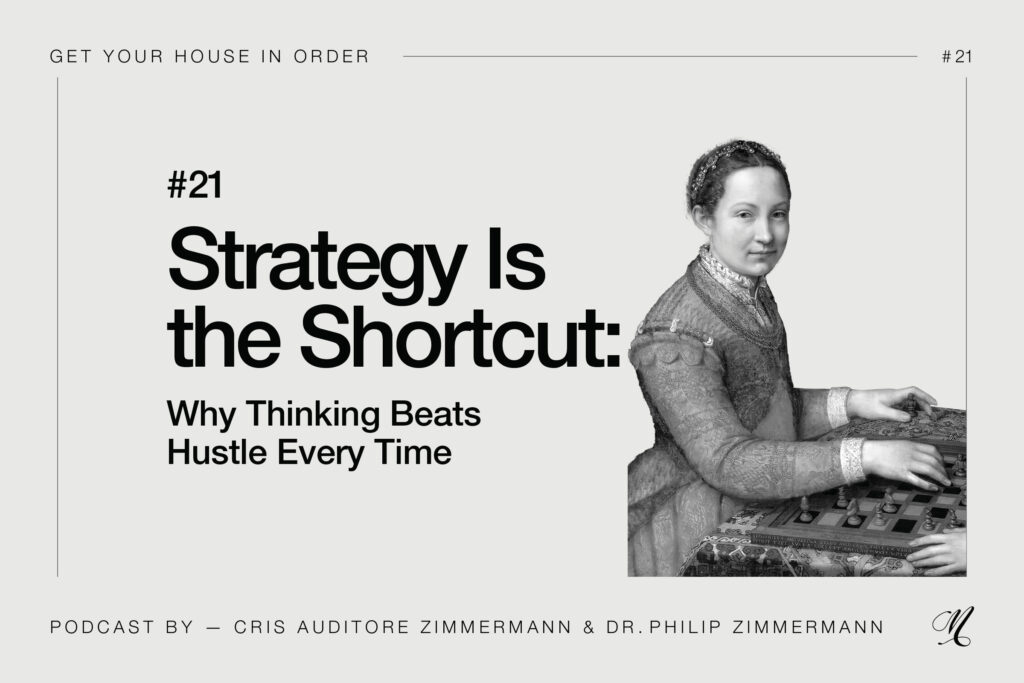
In a hustle-obsessed world, strategy is your ultimate shortcut. Cris Auditore and Dr. Philip Zimmermann reveal why thinking — not constant busyness — is the most powerful skill for entrepreneurs who want to build a self-managing business and a lasting legacy. Learn the four pillars of strategic thinking, how to shift from operator to strategist, and why slowing down is the fastest way to scale.
Most business owners dream of selling their company, but the reality is that many small businesses cannot be sold because they're too dependent on the owner. Creating a self-managing business that can operate without you is essential whether you plan to exit or not.
When a clinical psychologist told Cris "being a control freak is a sickness," it hit him like a hammer. For years, Cris had worn his controlling tendencies as a badge of honor, even priding himself on how his team would sit up straighter when he walked into the office. This revelation sparked a profound journey of self-examination that transformed his approach to both business and family life.
What would change in your business decisions if you were thinking 500 years ahead instead of just the next quarter? This thought-provoking question frames our exploration of legacy creation for entrepreneurs and business owners who want more than fleeting success.
What separates those who work endlessly from those who work efficiently? Systems. Most business owners remain trapped in operations because they excel at exciting new projects but fail to transform them into repeatable processes. If your business doesn't become boring, you can't scale it and you can't delegate it—a hard truth for adrenaline-seeking entrepreneurs.
What treasures are hiding in plain sight within your business? Discovering untapped revenue potential doesn't require radical transformation—just a strategic eye for the opportunities you've been overlooking.
Ever wonder why some businesses thrive while others struggle despite having great products? The answer might surprise you: it's all about sales. In this episode we explore why sales is the most critical skill for business success and wealth creation, revealing why even legendary figures like Martin Luther King were masterful salespeople.
Ruthless leadership isn't about cruelty—it's about decisiveness, stability, and the courage to make necessary choices that others avoid. Drawing from Machiavellian principles and Renaissance ruler strategies, Philip and Cris explore when and how business leaders must make "bloody decisions" to create thriving organizations.
By continuing to browse this site, you agree to our use of cookies.